

Local SEO is one of the highest-ROI growth channels for law firms because it targets people who are actively searching for legal help in a specific city, county, or neighborhood. When someone searches “DUI lawyer near me” or “personal injury attorney in {city},” Google tries to show the most relevant, trustworthy firms in that area—often through the Google Maps “Local Pack” and local organic results.
This guide walks you through a complete, attorney-specific local SEO strategy: Google Business Profile optimization, website structure, location and practice area pages, reviews, citations, legal directory strategy, link building, technical SEO, and how to measure results without guessing.
Table of Contents
- What Is Local SEO for Attorneys?
- How Google Ranks Local Results for Law Firms
- Google Business Profile Optimization for Attorneys
- Website Structure for Local SEO
- Local Keyword Research for Attorneys
- Content Strategy: Pillars, Clusters, and Local Guides
- Reviews and Reputation Management
- Citations and Legal Directories
- Local Link Building for Attorneys
- Technical SEO and Schema for Law Firms
- Tracking Results: Calls, Forms, Rankings, and ROI
- Common Local SEO Mistakes Attorneys Make
- How Long Local SEO Takes for Attorneys
- Local SEO Checklist for Law Firms
- FAQs
What Is Local SEO for Attorneys?
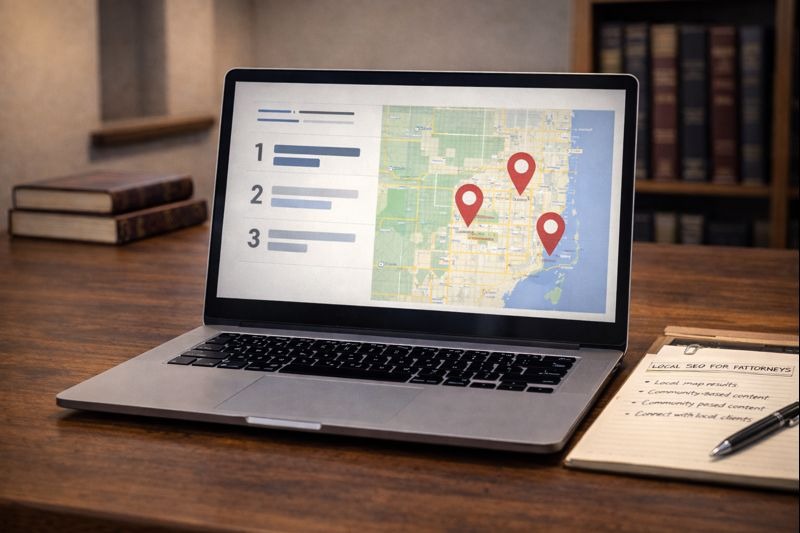
Local SEO for attorneys is the process of improving your visibility in local search results so prospective clients in your service area can find you when they need legal representation. It focuses on three major surfaces:
- Google Maps / Local Pack: The map results that often appear above organic listings.
- Local organic results: Traditional website results with local intent (city/county).
- Local discovery channels: Google Business Profile, reviews, citations, and legal directories.
Unlike general SEO, local SEO is highly tied to geography, proximity signals, and business entity authority. For law firms, the goal is not just traffic—it’s qualified inquiries (calls, consultations, case evaluations) from the right local clients.
How Google Ranks Local Results for Law Firms
Google’s local algorithm is often summarized into three primary factors. For competitive legal markets, you need to improve all three to win consistently.
1) Relevance
Relevance measures how closely your firm matches the search intent. You influence relevance through:
- Your Google Business Profile categories (primary and secondary)
- Services listed in your GBP (practice areas, sub-services)
- Practice area pages and content depth on your website
- On-page signals (titles, headings, copy, internal links)
2) Distance
Distance is proximity between the searcher and the business location (or the service area in some cases). You cannot “optimize” distance, but you can:
- Strengthen prominence so you compete beyond your immediate neighborhood
- Build location pages targeting nearby cities/communities you truly serve
- Improve conversion rate so you win more leads from the visibility you already get
3) Prominence
Prominence is your overall authority and trust online. For attorneys, prominence grows through:
- High-quality reviews and consistent reputation signals
- Citations across legal and local directories
- Local backlinks from relevant sites (community, press, organizations)
- Strong content that demonstrates expertise (E-E-A-T)
- Brand signals: mentions, consistent NAP, recognizable entity presence
Google Business Profile Optimization for Attorneys
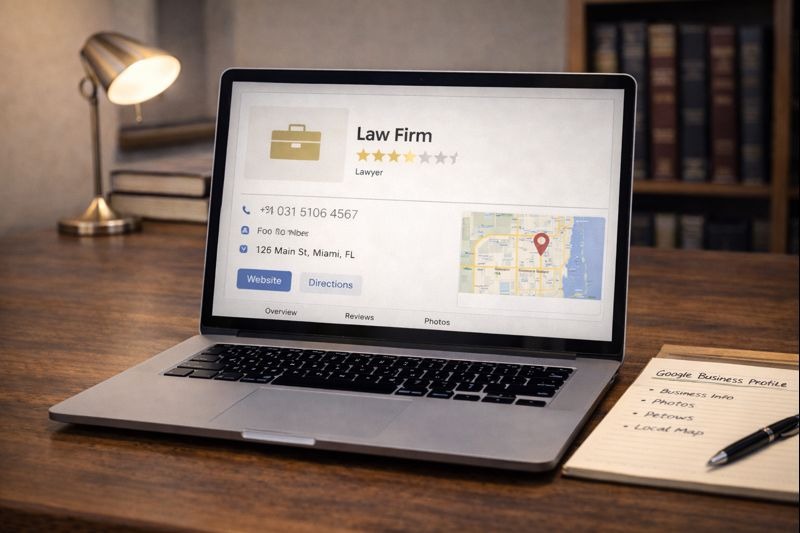
Your Google Business Profile (GBP) is often the biggest driver of local visibility, especially in “near me” searches. A properly optimized GBP supports both Maps rankings and trust at the exact moment a prospect is choosing who to contact.
Choose the right categories
- Primary category: pick the closest match (e.g., “Criminal Justice Attorney,” “Personal Injury Attorney,” “Family Law Attorney”).
- Secondary categories: only use services you genuinely offer. Avoid category stuffing.
Optimize the services section (practice areas)
Add your core practice areas as services and include sub-services where appropriate. For example:
- DUI / DWI Defense
- Drug Charges
- Domestic Violence
- Probation Violations
- Traffic Violations
Business description that builds clarity and trust
Write a clean, compliance-friendly description that clearly states:
- Who you serve (clients in specific cities/counties)
- Core practice focus
- What a client can expect (consultation, responsiveness, experience)
Photos and real-world credibility
Use authentic photos that increase trust:
- Office exterior/interior (helps users confirm legitimacy)
- Attorney headshots and team photos
- Branding signage if available
GBP posts and Q&A
- Posts: Use for updates, educational content, and time-sensitive announcements.
- Q&A: Add your own frequently asked questions with clear answers (avoid sensitive legal advice; keep it informational).
Spam prevention (highly important in legal niches)
- Monitor edits suggested by users
- Track competitor spam (keyword-stuffed business names)
- Keep your NAP consistent everywhere (website, citations, directories)
Website Structure for Local SEO
A strong law firm website supports local rankings by making your services and locations unmistakably clear to search engines and users.
Core pages every law firm should have
- Homepage: your primary location + core practice focus (clear, not vague)
- Practice area pages: one page per practice area (and key sub-services if needed)
- Location pages: one page per city/county you serve (unique content)
- Attorney bio pages: credibility signals, experience, bar admissions, memberships
- Contact page: phone, address, hours, map embed, clear intake CTA
Best-practice URL structure
Clean, logical structure helps both users and Google:
- Practice areas:
/practice-areas/dui-defense/ - Locations:
/locations/{city-state}/or/service-areas/{county}/ - Combined (optional):
/locations/{city}/dui-lawyer/(only if you can maintain uniqueness and quality)
Build a location system that scales without duplicate content
Location pages fail when they are thin or duplicated. A strong attorney location page typically includes:
- Clear service promise for that location (without misleading claims)
- Local context (courts served, neighborhoods, nearby landmarks)
- Practice-relevant FAQs for that city/county
- Internal links to related practice areas and nearby locations
- Trust signals (reviews snippet, case outcomes if compliant, memberships)
Internal linking that strengthens topical authority
Use internal links intentionally:
- From practice pages → to top locations served
- From location pages → to the most relevant practice pages
- From blogs → to the relevant practice page + relevant location page
Local Keyword Research for Attorneys
Attorney keyword research is about understanding how real clients search. In most markets, the highest value searches combine practice intent + location intent.
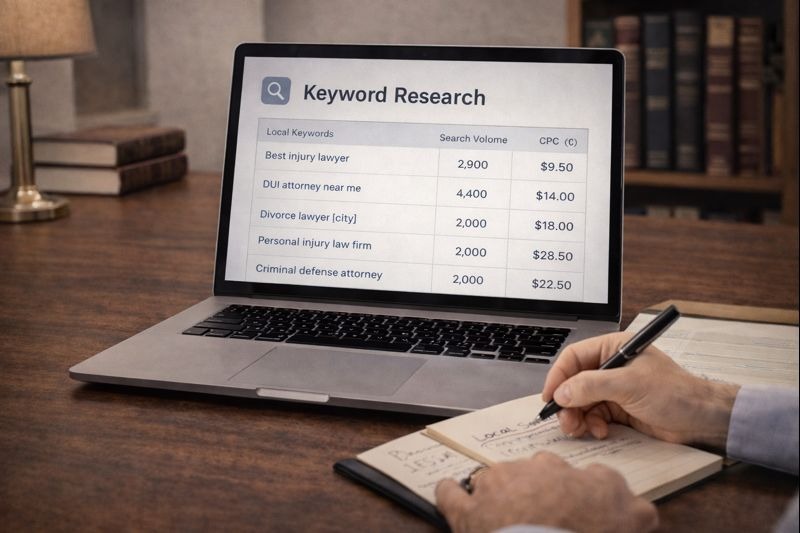
Local keyword patterns that convert
- [Practice] lawyer near me (high intent, competitive)
- [Practice] attorney in [City] (classic local)
- [Practice] lawyer [County] (often less competitive than city)
- [Charge/issue] lawyer (problem-first search, e.g., “assault charge lawyer”)
- Cost and process queries (e.g., “how much does a DUI lawyer cost in [City]”)
How to map keywords to pages
A simple mapping approach:
- Practice pages: target the core service keyword (e.g., “DUI Lawyer”)
- Location pages: target “Lawyer in {City}” / “Attorney in {City}” (broader)
- Combined pages: target “DUI Lawyer in {City}” (only if you can write deep, unique content)
- Blog content: target long-tail questions and informational intent
Quick local keyword research methods
- Google autocomplete and “People Also Ask”
- Search Console queries (existing impressions you can improve)
- Competitor practice pages (structure and sub-topics)
- Local service modifiers: “near me,” neighborhoods, nearby cities, county names
Content Strategy: Pillars, Clusters, and Local Guides
If you want consistent growth (not just small ranking wins), build content like a knowledge system. The most effective approach for attorneys is a pillar + cluster strategy.
Pillar pages (core, high-authority pages)
Pillar pages are deep, comprehensive resources (often your practice area pages). They should cover:
- What the legal issue is
- How the process works locally
- Common penalties/outcomes (informational, not guarantees)
- What to do next (consultation CTA)
- FAQs that match real search questions
Cluster posts (supporting content that feeds the pillar)
Clusters are focused blog posts that answer specific questions, then link back to the practice area page. Examples:
- “First-time DUI penalties in {State}”
- “Will I lose my license after a DUI in {State}?”
- “What happens at a DUI arraignment in {County}?”
- “How long does a DUI stay on your record in {State}?”
Local guides that increase geographic relevance
Local guides help your firm feel “present” in the community:
- “How to find the courthouse in {City}” (practical, helpful)
- “What to expect at {Court Name} for a traffic hearing”
- “Common mistakes after an arrest in {County}”
Reviews and Reputation Management
Reviews are both a ranking signal and a conversion signal. In legal services, they often determine who gets the call.

Review factors that matter most
- Volume: a steady stream looks more credible than bursts
- Recency: newer reviews influence trust and can support local visibility
- Quality: detailed reviews tend to convert better
- Owner responses: professional responses show reliability
How to request reviews ethically
- Use a simple post-case review request process
- Do not incentivize reviews
- Avoid scripting exact wording; ask for honest feedback
- When appropriate, encourage details about service experience (communication, professionalism)
Handling negative reviews
- Respond calmly and professionally
- Avoid revealing confidential details
- Offer an offline resolution path
- Document patterns—sometimes negative reviews are competitor spam
Citations and Legal Directories
Citations are online mentions of your firm’s name, address, and phone number (NAP). Consistency across the web helps Google validate your firm as a real, reputable entity.
Where attorneys should build citations
- Legal directories: Avvo, Justia, FindLaw, Lawyers.com (and other reputable platforms)
- Local directories: chamber of commerce, local business listings
- General directories: select only high-quality sources; avoid spam networks
Consistency rules that prevent ranking issues
- Use the exact same business name format (no keyword stuffing)
- Keep phone number and address identical everywhere
- Use one canonical website URL version (https, www or non-www)
- Update old listings after moves, number changes, or rebrands
Local Link Building for Attorneys
Backlinks remain one of the strongest authority signals. For local SEO, the goal is not “lots of links.” The goal is relevant, local, trustworthy links that support prominence.
High-quality local backlink opportunities
- Local newspapers and community publications
- Sponsorships (sports teams, events, nonprofits) with a real listing link
- Bar associations and legal organizations
- Local business partnerships (professional, ethical referrals)
- Speaking engagements and educational workshops
Content that naturally attracts links
- State-specific legal guides
- Statistics summaries (properly cited and explained)
- “What to do after…” safety/legal checklists (informational)
- Local court process explainers
Technical SEO and Schema for Law Firms
Technical SEO ensures Google can crawl, interpret, and trust your website efficiently. In legal markets, technical issues quietly destroy rankings because competitors are investing heavily.
Core technical priorities
- Speed / Core Web Vitals: improve load time and interaction stability
- Mobile UX: many legal leads come from mobile “near me” searches
- Indexability: ensure important pages are crawlable and not blocked
- Duplicate content control: avoid thin variations and copied location pages
- Clean site architecture: logical menus, breadcrumbs, and internal links

Schema (structured data) that helps local SEO
Schema helps search engines and AI systems understand your firm as an entity. Recommended schema types include:
- LocalBusiness / LegalService
- Attorney (where appropriate)
- FAQPage (on pages with true Q&A sections)
- BreadcrumbList
- Article (for blog posts)
E-E-A-T signals for attorney websites
- Detailed attorney bios (experience, education, admissions, memberships)
- Clear editorial standards for content (accuracy, updates)
- Transparent contact information and firm details
- Helpful content that demonstrates real expertise (not generic marketing copy)
Tracking Results: Calls, Forms, Rankings, and ROI
Local SEO only works when you track the outcomes that matter. Rankings are useful, but law firms should measure leads and signed cases.
What to track monthly
- Google Business Profile: calls, directions, website clicks
- Website conversions: calls, form submissions, chat inquiries
- Search Console: impressions and clicks for practice + location queries
- Rank tracking: priority keywords in specific locations
- Intake quality: qualified leads vs. unqualified calls
Simple ROI framework for attorneys
Estimate ROI with real business numbers:
- Monthly qualified leads from SEO
- Consultation-to-client conversion rate
- Average case value (conservative estimate)
- Cost of SEO investment
Common Local SEO Mistakes Attorneys Make
- Thin location pages: generic pages with swapped city names rarely rank long-term.
- Duplicate content: repeated text across many locations weakens authority signals.
- Wrong GBP categories: misalignment reduces relevance for key searches.
- Ignoring reviews: low review velocity hurts prominence and conversions.
- Spammy backlinks: low-quality link blasts often backfire in legal niches.
- No internal linking strategy: pages exist but don’t support each other’s rankings.
- Weak attorney credibility signals: missing bios, memberships, citations, or clear firm info.
How Long Local SEO Takes for Attorneys
Local SEO is a compounding strategy. Typical timelines vary by market competition, website quality, and consistency of effort:
- Weeks 1–4: GBP cleanup, technical fixes, better on-page relevance, early improvements
- Months 2–3: location pages and practice pages begin gaining traction
- Months 4–6: consistent local visibility and lead flow if strategy is executed properly
- Months 6–12: stronger dominance as authority signals compound (reviews, links, content)
Local SEO Checklist for Law Firms
- Claim and fully optimize Google Business Profile
- Choose accurate GBP categories and add detailed services
- Ensure NAP consistency across site + directories
- Create deep practice area pages (not thin summaries)
- Create unique, valuable location pages for true service areas
- Implement an internal linking system between practice, location, and blog content
- Collect reviews consistently and respond professionally
- Build high-quality citations (legal + local)
- Earn relevant local backlinks (not spam)
- Improve speed, mobile UX, indexability, and schema
- Track calls/forms/GBP actions and refine monthly
FAQs: Local SEO for Attorneys
Do law firms need location pages if they already rank in Google Maps?
Yes. Google Maps visibility can fluctuate. Strong location pages support local organic rankings, strengthen relevance, and help you capture more searches beyond your immediate proximity—especially in competitive markets.
Should attorneys create one page per city and one page per practice area?
In most cases, yes. Practice pages capture service intent, while location pages capture geographic intent. If you create combined pages (practice + city), they must be genuinely unique and deep to avoid thin or duplicate content issues.
How many reviews does a law firm need to compete locally?
There is no universal number. The goal is to match and exceed local competitors over time with a steady review velocity. Quality, recency, and professional responses often matter as much as raw count.
Are legal directories worth it for local SEO?
Reputable legal directories can help with citations, visibility, and trust. Focus on high-quality platforms and consistent NAP information rather than mass submissions to low-value directories.
What’s the fastest way to improve local rankings for a law firm?
Start with Google Business Profile optimization, fix NAP consistency, improve practice area pages, and build a small set of high-quality citations. After that, publish content that answers real client questions and earn local backlinks.
Need Local SEO Built Specifically for Law Firms?
If you want a structured local SEO strategy—practice pages, location pages, GBP optimization, content planning, and technical improvements—implemented the right way for competitive legal markets, Legal Authority Online can help you build long-term authority and consistent case inquiries.
Next step: Request a consultation and we’ll review your current visibility, local competitors, and the quickest opportunities to improve rankings and lead flow.