

Legal decisions are rarely made casually. They are shaped by urgency, trust, clarity, and confidence. Today, that decision-making process almost always begins online, long before a consultation is scheduled or a phone call is placed. For law firms, search visibility is no longer optional—it is a core component of professional credibility.
SEO for law firms is not about chasing rankings or traffic in isolation. It is about ensuring that when someone actively seeks legal guidance, your firm appears with authority, accuracy, and the professionalism expected of the legal profession.
Why SEO Plays a Different Role in the Legal Industry
The legal industry operates in a high-trust, high-stakes environment. Clients are often facing significant personal, financial, or legal consequences. They are not simply comparing service providers; they are assessing competence, reliability, and understanding.
This reality fundamentally changes how SEO must be approached for law firms. Effective legal SEO prioritizes intent over volume and clarity over persuasion. It focuses on:
- Searches driven by real legal needs rather than casual interest
- Accurate explanations instead of exaggerated claims
- Authority signals that reinforce trust and professionalism
- Clear guidance through complex legal situations
In this context, SEO becomes an extension of legal credibility rather than a traditional marketing channel.
From Search Visibility to Digital Legal Authority
Ranking for legal keywords is only the beginning. What matters far more is how your firm is perceived once a user engages with your content. Search engines increasingly evaluate whether legal content demonstrates real understanding, professional experience, and the ability to answer questions clearly and responsibly.
For law firms, this means content must function like a knowledgeable legal professional—structured, precise, and informative—rather than generic promotional copy. When executed correctly, SEO positions your firm as a trusted source of legal understanding, not merely a service listing.
How People Search for Legal Help Online
Legal search behavior typically follows several predictable patterns, each requiring a different content approach.
Immediate-Need Searches
These searches are often urgent and time-sensitive. Users are seeking quick clarity, reassurance, and next steps. Content addressing these queries must be direct, authoritative, and easy to understand.
Research and Comparison Searches
Here, users are evaluating options, learning about legal processes, and assessing expertise. Depth, structure, and logical explanation matter more than brevity. This is where well-developed educational content builds confidence.
Educational and Awareness Searches
Some users are not ready to engage a lawyer immediately but are building foundational knowledge. High-quality educational content establishes early trust and long-term visibility, often influencing future decisions.
A strong legal SEO strategy supports all stages of this journey, ensuring your firm remains visible throughout the decision-making process.
Why Generic SEO Strategies Fail Law Firms
Many law firm websites struggle online not because SEO is ineffective, but because it is applied incorrectly. Generic SEO approaches often overlook the nuances of legal search behavior and professional expectations.
Common issues include thin content, over-optimization, and the use of marketing language that undermines trust. Search engines can now identify content created solely to rank rather than to inform. In the legal space, shallow or misleading content damages credibility with both users and algorithms.

Practice-Area Authority and Topical Depth
Search engines evaluate authority on a topic-by-topic basis. A law firm is not assessed as a single entity, but as a collection of practice-area expertise.
This means each practice area should be supported by its own authoritative content, clear internal structure, and logical linking. Supporting articles play a crucial role by reinforcing core service pages and expanding topical relevance.
When practice-area authority is built correctly, a law firm’s website functions like a well-organized legal reference rather than a digital brochure.
Content That Reflects Real Legal Expertise
High-performing legal content shares several defining characteristics. It explains before it persuades, maintains a professional yet accessible tone, and breaks down complex concepts logically without oversimplification.
Effective legal content avoids guarantees and exaggerated claims. Instead, it demonstrates understanding, responsibility, and real-world awareness. This approach naturally earns engagement, trust, and long-term search visibility.
Supporting SEO With a Strong Digital Foundation
While SEO for law firms is central to building digital authority, it performs best when supported by a solid technical and structural foundation. Search visibility depends heavily on how a website is designed, maintained, and structured.
Well-planned website design and redesign efforts improve clarity, usability, and content hierarchy. Ongoing website maintenance ensures performance, security, and consistency. Accurate Google Business Profile optimization strengthens local trust signals, while AI-driven optimization helps adapt content to evolving search behavior.
Together, these elements ensure a law firm’s online presence remains credible, adaptable, and aligned with how legal clients search and evaluate information.
Measuring Legal SEO Success Correctly
Legal SEO should never be judged solely by traffic or rankings. Meaningful success is reflected in engagement quality and real client actions.
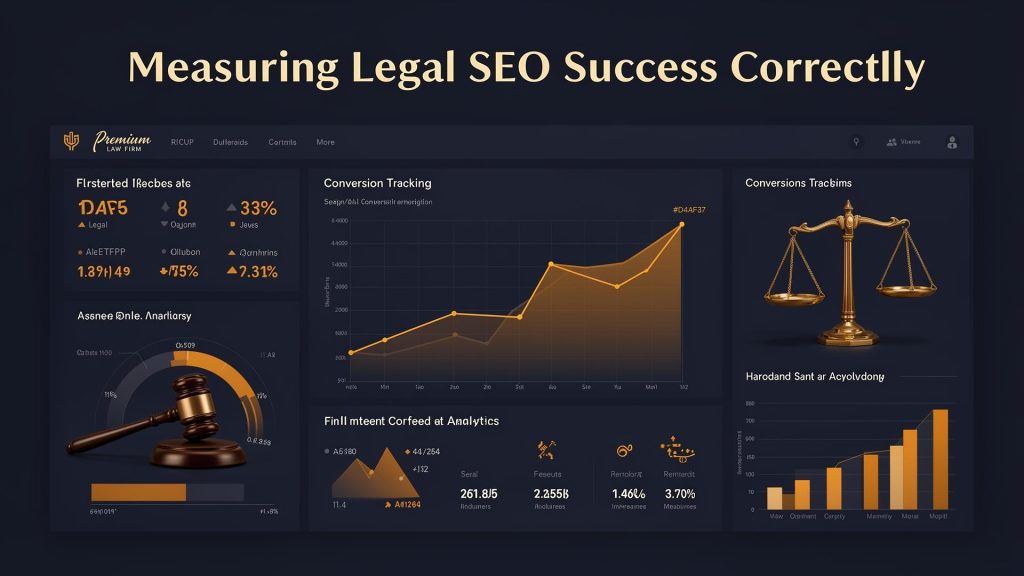
- Consultation requests connected to specific content
- Time spent engaging with legal explanations
- Repeat visits from research-oriented users
- Practice-area-specific conversion performance
When these indicators improve, sustainable rankings tend to follow naturally.
SEO as a Long-Term Asset for Law Firms
Unlike short-term advertising, legal SEO compounds over time. Each authoritative page strengthens overall topical relevance. Each supporting article reinforces core practice areas.
When treated as a long-term asset, SEO becomes part of a firm’s professional infrastructure—supporting growth, credibility, and visibility without constant reliance on paid channels.
Digital Authority Is Built Through Consistent SEO Strategy
Strong search rankings for law firms are earned through consistent optimization, authoritative content, and technical precision over time. Digital authority is not a one-time effort—it is built by aligning SEO strategy with how clients search, evaluate, and trust legal brands online.
At Legal Authority Online, we focus on helping law firms strengthen their digital authority through SEO practices that support visibility, credibility, and sustainable growth.
Final Perspective
SEO for law firms is not about manipulating search engines. It is about aligning legal expertise with how people seek answers, assess trust, and make decisions online.
Firms that approach SEO with the same discipline they apply to legal work—precision, clarity, and responsibility—build digital authority that lasts. At Legal Authority Online, this principle guides every strategy and every piece of content we create.