

Most attorneys focus on keywords, backlinks, and content — but one of the most powerful SEO techniques for law firms is often ignored: internal linking. A strong internal linking system helps Google understand your website, improves rankings across all practice areas and locations, and guides potential clients to the pages that matter most.
At Legal Authority Online, we design clear and scalable internal linking systems specifically for law firms. This guide explains exactly how internal links work, why they matter, and how to use them to create a high-performing legal website.
What Is Internal Linking?
Internal links are links that point from one page on your website to another page on the same domain. They help both users and search engines understand your site’s structure. While external links affect authority from outside websites, internal links help distribute authority within your own website.
For law firms with multiple practice areas, case types, counties, and cities, internal links are essential for organizing content and increasing visibility.
Why Internal Linking Matters for Law Firm SEO
Internal links serve several important roles in a legal website:
- Improved Navigation: Visitors can easily find related practice areas, offenses, or locations.
- Faster Indexing: Google uses internal links to discover and crawl your pages more efficiently.
- Stronger Rankings: Linking from high-authority pages boosts the visibility of newer or deeper pages.
- Better User Engagement: Readers spend more time on the website, which is a positive ranking signal.
A law firm may publish dozens or even hundreds of location and services pages — internal linking ensures they all work together rather than competing or being ignored by search engines.

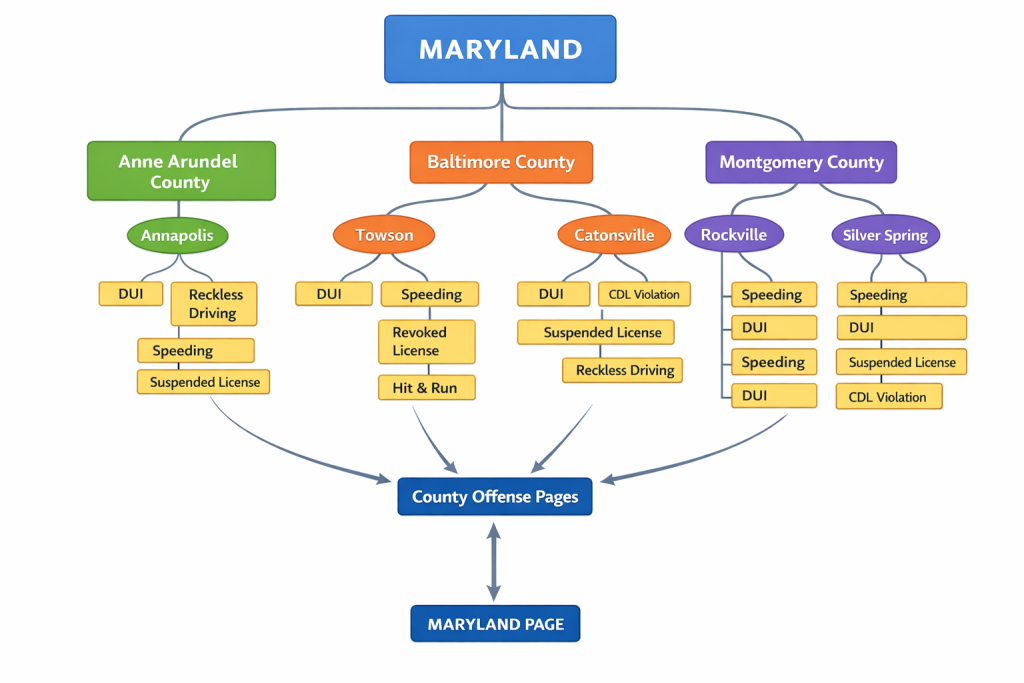
The Legal SEO Silo Structure (The Most Effective System)
The most powerful internal linking strategy for law firms is a silo structure. This organizes your website into clear layers so Google understands exactly how your pages relate.
1. State-Level Pages (Top Tier)
These target broad, high-search keywords like “Maryland Traffic Lawyer.” They act as the parent level in your structure.
2. County-Level Pages (Middle Tier)
These pages represent each county you serve. For example: “Montgomery County Traffic Lawyer.” Many websites skip this tier, but it is essential for strong rankings.
3. City-Level Pages (Bottom Tier)
These pages target clients searching locally, such as “Rockville Speeding Ticket Lawyer,” “Towson DUI Lawyer,” etc.
This results in a clear hierarchy:
State → County → City → Offense Pages
Google rewards websites that follow this logical structure.
How Link Flow Works Inside the Silo
Here’s how each page should link within the structure:
🔵 State Pages Should Link To:
- All county-level hub pages
- Major statewide criminal/traffic practice pages
- Important guides and resources
🟧 County Pages Should Link To:
- All city pages within that county
- All offense-type pages for that county (DUI, speeding, reckless, etc.)
- The statewide parent page
🟩 City Pages Should Link To:
- The parent county page
- Other related offenses within the same city
- Relevant statewide practice pages
This creates a complete loop where authority flows between all related pages.
Example Internal Linking Flow for a Law Firm
Here’s how a real internal linking system looks for a traffic defense lawyer:
Maryland Traffic Lawyer
    ↓
Montgomery County Traffic Lawyer
    ↓
Rockville Speeding Ticket Lawyer
    ↓
Rockville Reckless Driving Lawyer
    ↓
Rockville DUI Lawyer
Each page connects naturally and strengthens the others.
Anchor Text Best Practices for Attorneys
Anchor text is the clickable text of a link. It must be clear, descriptive, and relevant.
Good examples:
- “Montgomery County traffic defense services”
- “Learn more about Maryland DUI penalties”
- “Legal representation for speeding violations”
Bad examples:
- “Click here”
- “Read this”
- Keyword stuffing the same phrase repeatedly
Google uses anchor text to understand context, so it must feel natural and helpful.

Where to Add Internal Links on Law Firm Pages
You should include internal links in:
- Intro paragraphs (quick navigation for readers)
- Body text (contextual relevance)
- FAQ sections (helpful next steps)
- Sidebars (location or practice area menus)
- Footers (global navigation links)
For large law firm websites, internal linking is ongoing — every new page should be added into the silo.
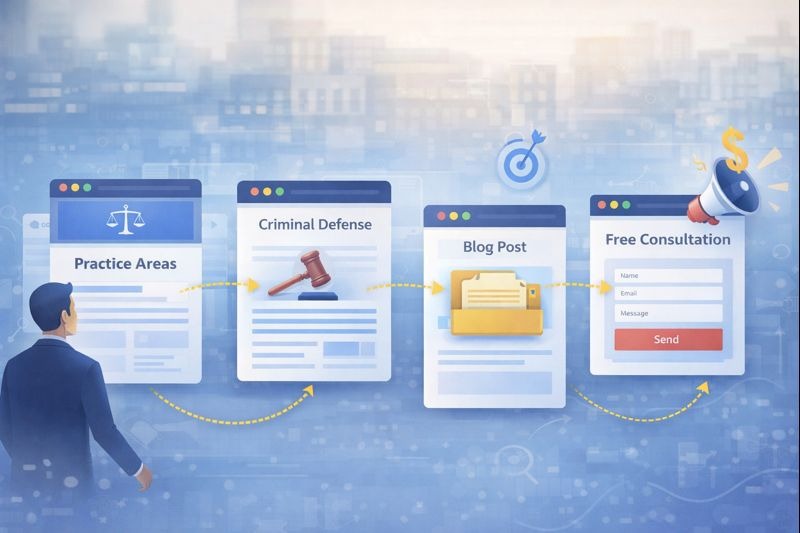
How Internal Linking Boosts Conversions
Internal links aren’t only for SEO — they also guide potential clients toward taking action:
- Linking to contact pages from practice pages increases inquiries.
- Linking related case types helps clients understand your full services.
- Linking locations guides clients to the page that matches their court.
Good internal linking equals a better user experience and higher conversion rates.
Internal Linking Mistakes Law Firms Should Avoid
- Not linking pages to each other at all
- Linking randomly without a structure
- Using the same anchor text everywhere
- Linking to irrelevant pages just to add links
- Forgetting to update links when adding new pages
A clean internal linking strategy prevents these problems and keeps your site organized.
How Legal Authority Online Helps Law Firms Build Powerful SEO Structures
We specialize in creating custom internal linking systems for law firms, including:
- Building full state → county → city silo structures
- Creating county and city hub pages for better rankings
- Optimizing anchor text for legal SEO
- Organizing practice areas with supporting content clusters
- Fixing broken links and strengthening page authority
With a well-designed internal linking system, every new page you publish becomes easier to rank — and your entire site becomes stronger.
Final Thoughts
Internal linking is one of the most important — and most underused — SEO strategies in the legal industry. When done properly, it organizes your content, improves rankings across all practice areas and locations, and guides clients to the information they need.
You don’t need hundreds of backlinks to rank well — you need a website that Google understands clearly. A strong internal linking strategy delivers exactly that.
Need help building your law firm’s internal linking structure? Legal Authority Online can build it for you.